





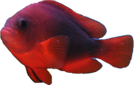
Sustainable Aquatics Tank Bred Clownfish
Clownfish, often called “anemone fish,” belong to the subfamily Amphiprioninae in the family Pomacentridae. Approximately 29 species are recognized – there remains a healthy debate about the number of species in the subfamily with new species recently named. All species fall within the genus Amphiprion with one exception, the maroon clownfish of the genus Premnas.
“Nemo” and his mother and father (“Coral” and “Marlin”) in the Pixar movie “Finding Nemo” are clownfish.
Clownfish are a type of damselfish, so they are closely related to the sergeant majors, blue devils and the like as well as being more distantly related to the cichlids as fellow members of the suborder Labroidei, grouped together because of jaw morphology.
Clownfish are found in tropical to subtropical warmer waters from the west coast of Africa to the Red Sea and the Persian Gulf, the Arabian and Indian seas, and down to the east coast of Australia as far south as Lord Howe Island, north to the Philippines and southern Japan and out toward the mid and western Pacific as far east as Fiji. They are not naturally found in Atlantic, Caribbean or Mediterranean waters.
Clownfish are excellent pets for both fish tanks and reef tanks and will coexist with most all aquarium animals and environments with or without their host anemone. They can be very long-lived; documented evidence shows they can live more than 30 years. A wide range of temperaments are found, from the more docile percula and ocellaris to the more aggressive and territorial tomatoes and Clarkii, for example.
Most clown fish associate in nature with very specific host specific anemones. In this sense they are very territorial. Once they settle out on an anemone, it is believed they may spend the rest of their lives within a short distance of this anemone. In our hatchery we often give them a clay flowerpot which they will claim as a territory and shelter.
In introducing the clownfish species of the world’s oceans and especially those bred at Sustainable Aquatics, we would like to offer some notes and observations:
- Clown fish are very territorial; in nature one never finds a clown fish outside of the territory defined by its anemone;
- We believe based on our observations at SA that juvenile clownfish are all functional males when small/young and that there is a one-way passage from male to female;
- When one finds a dominant pair on an anemone, the larger fish is most always the female, though some do not exhibit as much dimorphism as others, and there are often what we like to think of as juveniles in attendance. We believe that it is in the interest of the species that the juvenile is a male as if the female is lost; the male mate will usually be older and larger than the juveniles and will quickly become a female and pick up a mate from one of the juveniles in attendance. We once replaced a lost male of a pair in the morning before a scheduled spawn and had fertile eggs that evening!
- When adding a pair of clown fish to a tank, keep in mind they will most likely take up residence in part of the tank and protect themselves in that territory. At SA we provide the pairs with shelters. In general, they will be safe from predators and larger fish once they have established a territory.
- It is not known how long clown fish live in the wild; predation and natural disasters like storms and earthquakes are probably the largest morbidity factors. However, a pair of clown fish at the Shedd Aquarium is known to have lived more than 30 years, and at SA we have many pairs older than 10 years and some older than 20 years. We believe that with good water quality and nutrition, it is not unreasonable to hope that a pair could live longer than 20 years in an aquarium!
- The size of tank or habitat required is a function of the species and husbandry. We have a very happy pair of white-striped maroons spawning in a 14 gallon desktop reef. We once had a pair of ocellaris spawning in a 1.5 gallon novelty aquarium! Some species growing to larger adult sizes benefit from much larger environments, such as the clarkii, tomato, latezonatus, some maroons and the like.
- Eggs typically hatch in about a week after fertilization depending upon species and temperature, and the larvae that emerge are about 3 mm in size. In about a week or so they go through metamorphosis. Survival rates of hatched larvae in the wild are very low.
- The typical clown fish prefers a water temperature on the warmer side, about 80 degrees Fahrenheit. Most species will become uncomfortable if the temperature dips into the low 70’s F. They can easily tolerate temperatures of 84 and higher, especially if oxygen is high and food is present to accommodate their increased metabolism.
- Depending upon species, SA begins offering our clown fish for sale when they are about 1.5 inches, though we offer a “nano” size that is 0.75-1”. We also keep a stock of most species in the jumbo and large sizes. These varying sizes are a great way to form pairs.
- Nutrition and water quality during their development is critical to growth, barring, health, and color. SA prides itself on being able to offer attractive clown fish based on very well-defined processes in these regards. At SA our yields on larvae is very high; we believe that if conditions are poor enough that many fish do not survive, the remaining fish, although alive, are compromised. Therefore, high yield is not just about controlling costs, but also about controlling quality!
- SA’s hatchery bred and raised clown fish, as well as our other families of aquacultured fish are fed the SA Hatchery Diet as a staple food for their entire post metamorphosis life with us. It is a complete diet and has special features we believe are not found in any other dry or prepared foods. Read here for more information about the SA Hatchery Diet.
- When the clown fish deposit a nest of eggs, they appear bright orange at first (if diet and conditions are optimal) and over time, the color darkens until the silvery eyes become visible and the eggs are prepared to hatch, which happens after sundown during the evening. Upon escaping the egg, the larvae swim up in the water column and begin hunting zooplankton for the duration of their short larval period.
- SA believes that both Percula and Ocellaris clown fish are very hardy, and note that they do not co-exist in nature in the same territory. Also, while the Percula can evolve black patterns over time, the Ocellaris typically retains its pattern and markings. We cannot say which was “Nemo”, but from a geography point of view it would suggest A. percula.
- The Black Ocellaris is a naturally-occurring variety of clownfish with a black body and white stripes. It is only found only in a small geographic area near Darwin, Australia.
- In our many dives over a wide range of territory, for instance Red Sea, Persian Gulf, Oman, Arabian Sea, Japan, Coral Sea, Indochina, Australia, Fiji, Solomon Islands, we have often noted the fact that many species will coexist on the same reef. We often, even typically, see many variants. The range of variants often seems endless. Many of the designer clowns we breed represent actual variants found in nature, although selectively exaggerated through careful breeding in the hatchery.